A common demonstration done by many makers online is to play music out of a motor (e.g., drone motor, stepper motor, brushed DC motor). In fact, certain varieties of drone ESC will purposefully play music out of the motor on startup (e.g., Bluejay / BLHeli). However, most of these demos use small motors with small motor controllers. Most discourse around making sound using large motors amounts to car enthusiasts complaining about the relative silence of EV powertrains.
Although it is rare to see, it's possible to do the same type of demo using a much larger motor.
How does the motor make sound?
The rotor in a motor experiences forces axially, radially, and tangentially. Generally, when modelling a motor, we only care about the forces that are tangential to the rotor (i.e., forces that produce torque). Many motor models (e.g., those in [1]) reflect this focus, as they elide the axial and radial forces. However, these forces contribute significantly to sound.
While both radial and axial flux motors can make sound, the disk-shaped rotor in an axial flux motor tends to produce more noise when it vibrates.

By leveraging Maxwell's stress tensor, it is possible to analyze these non-torque-producing forces on the rotor. For example, in an axial flux PMSM, the derived force density (i.e., force per area) between the rotor and stator faces is[2]
where is the axial flux density, and is the tangential flux density. Averaged spatially over the disk, we have . To maximize change in force, we would like to maximize
At low load, , so it will be most effective to induce vibration by wiggling .
Recall the space equation of state for a PMSM[3]
where:
- is the stator flux linkage on the and axes
- is the phase-to-neutral voltage on the and axes
- is the phase-to-neutral resistance of the stator windings
- is the phase-to-neutral current on the and axes
- is the rotor's electrical angular velocity (in rad/s)
- and are the - and -axis inductances
- is the -axis flux linkage contributed by the rotor's permanent magnet
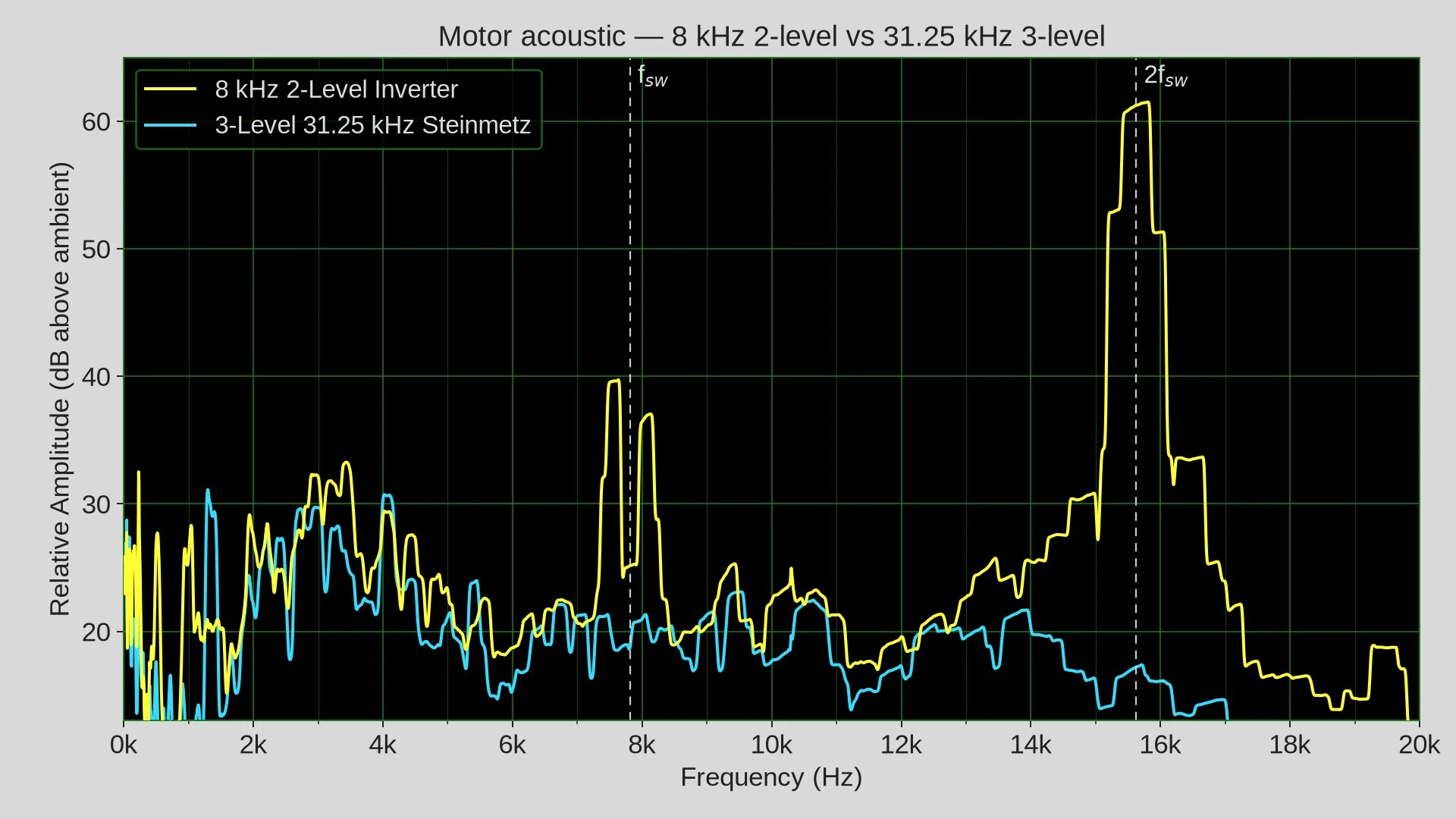
Therefore, for the purpose of vibrating the rotor to play specific audio (i.e., up to ~15.6 kHz, well above for our purposes), it is sufficient to modulate at similarly high frequencies.
Actually playing music
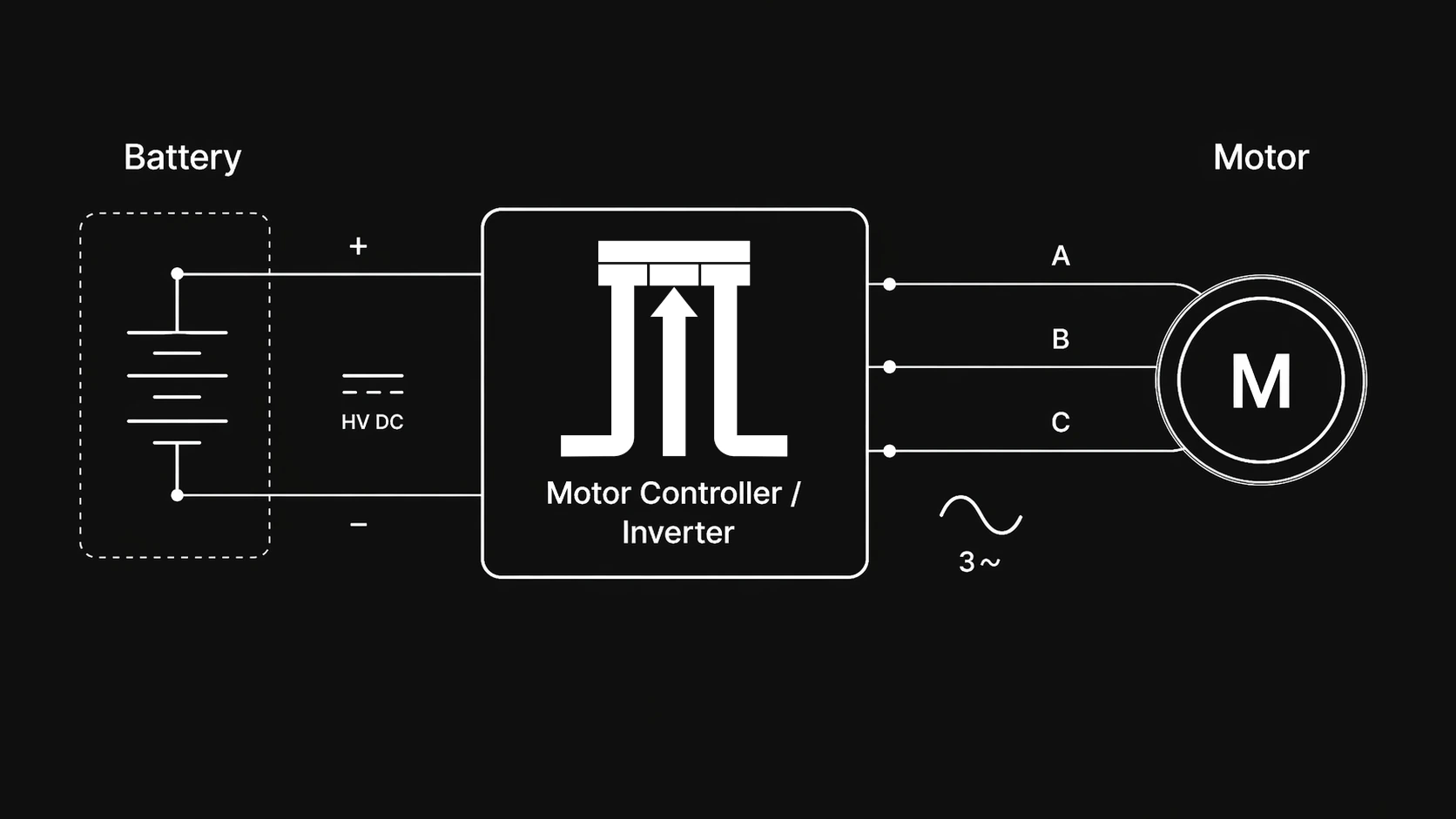
The Steinmetz MC0-500 is a high performance, high power traction inverter. Its high switching frequency allows us to modulate at 31.25 kHz. Additionally, its support for 100BASE-T1 automotive ethernet allows us to easily livestream uncompressed S16LE audio (a 500 kbps bit rate) into the firmware.
These two aspects mean that we truly use the inverter as a networked speaker, as opposed to using it as a MIDI-style device to play sine waves hardcoded into the firmware.
Our demo below was orchestrated as follows:

Result
References
- D. C. Hanselman, Brushless Permanent Magnet Motor Design, 2nd ed. Lebanon, OH, USA: Magna Physics Publishing, 2006.
- F. Zhao, Z. Shao, and H. Fan, "Analytical calculation and low-order component optimization of axial electromagnetic force for an axial flux motor," IEEE Trans. Magn., vol. 59, no. 11, Nov. 2023, Art. no. 8202705. doi:10.1109/TMAG.2023.3282739
- A. Varatharajan, G. Pellegrino, and E. Armando, "Direct flux vector control of synchronous motor drives: A small-signal model for optimal reference generation," IEEE Trans. Power Electron., vol. 36, no. 9, pp. 10526–10535, Sep. 2021. doi:10.1109/TPEL.2021.3067694